
AUTHORS & AFFILIATION
Muhammad Sontang Sihotang, ^{1,*}, Lukman Hakim^1, Dara Aisyah^2
Faculty of Mathematics & Natural Sciences, Universitas Sumatera Utara, Jl. Bioteknologi No. 1, Kel. Padang Bulan, Kec. Medan Baru, North Sumatra 20155, Indonesia
Faculty of Social & Political Sciences, Universitas Sumatera Utara, Jl. Prof Dr Sofian No. 1 A, Kel. Padang Bulan, Kec. Medan Baru, North Sumatra 20155, Indonesia
Corresponding Author : Muhammad Sontang, e-mail:
muhammad.sontang@usu.ac.idABSTRACT
The relentless growth of municipal green waste and hazardous industrial residues presents a compelling opportunity to engineer advanced, eco-friendly solid fuels that accelerate the transition toward Net Zero Emissions (NZE). Herein, we report the novel synthesis and performance evaluation of hybrid bio-briquettes formulated from high-energy ball-milled nanocarbon derived from Universitas Sumatera Utara (USU) dry leaf waste and industrial Baking Filter Dust (BFD) from PT INALUM. Nanocarbon particles ($<100\text{ nm}$) were synthesized via carbonization at 500\ ^\circ\text{C} followed by High Energy Ball Milling (HEBM) for 10\text{ h}. Hybrid briquettes were compacted at 140\text{ bar} across six compositional ratios (BKH-1 to BKH-6) using a 10\text{ wt}\% tapioca starch binder.Characterization via SEM-EDX, XRD, FTIR, XRF, and PSA confirms that nanoscaling significantly increases specific surface area and densification, leading to improved thermochemical reactivity. The optimal hybrid formulation achieved a high heating value (HHV) exceeding 7000\text{ cal/g}, substantially outperforming conventional biomass briquettes (6100–6500\text{ cal/g}) and fully satisfying Indonesian National Standards (SNI 01-6235-2000) with moisture content <8\%, ash content <8\%, fixed carbon \ge 80\%, and compressive strength \ge 50\text{ kg/cm}^2. Flue gas emission analysis demonstrated a >20\% reduction in {CO} and {CO}_2 emissions, accompanied by a +15\% increase in overall combustion thermal efficiency. Techno-economic analysis yields an estimated production cost under {Rp }7,000/{kg}, proving its feasibility as a low-cost, green alternative to Liquefied Petroleum Gas (LPG) in domestic and small-scale industrial applications.
Keywords: Hybrid Bio-Briquette; Nanocarbon; Baking Filter Dust; Waste-to-Energy; Circular Economy; Net Zero Emission.
INTRODUCTION
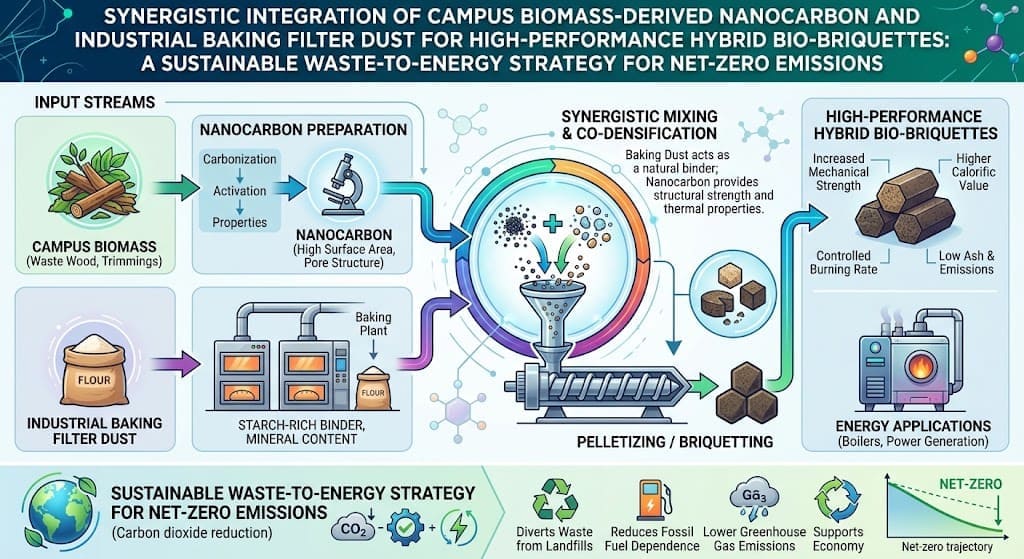
Global energy demands and national commitments toward Net Zero Emissions (NZE) by 2060 mandate an urgent shift from fossil fuels to sustainable, waste-derived energy alternatives. In developing regions, domestic cooking relies heavily on imported Liquefied Petroleum Gas (LPG). Simultaneously, urban university campuses generate massive quantities of dry leaf biomass, which are often burned openly or landfilled, causing localized air pollution.
Conversely, primary aluminum smelting facilities generate industrial carbon waste known as Baking Filter Dust (BFD), which, despite containing valuable carbonaceous minerals, remains underutilized.
                        +----------------------------------------+
                        |      SUSTAINABLE CIRCULAR ECONOMY      |
                        +----------------------------------------+
                                      /            \
                                     /              \
                                    v                v
              +-----------------------------+    +-------------------------------+
              |   CAMPUS BIOMASS WASTE      |    |    HAZARDOUS INDUSTRIAL WASTE |
              | USU Dry Leaves Carbonization|    | (INALUM Baking Filter Dust /  |
              |     + HEBM Nanostructuring) |    |       BFD Carbon Matrix)      |
              +-----------------------------+    +-------------------------------+
                                    \                /
                                     \              /
                                      v            v
                        +----------------------------------------+
                        |  HYBRID NANOCARBON SOLID BIO-FUEL      |
                        | (HHV > 7000 cal/g, Low CO/CO2 Emission)|
                        +----------------------------------------+
Prior efforts by Sihotang et al. established that dry leaf biochar and micro-sized BFD can yield charcoal briquettes with heating values around 6115–6557 { cal/g}. However, conventional micro-particle briquettes suffer from low energetic density, slow ignition kinetics, and incomplete combustion leading to gas emissions.
Nanotechnology offers a promising pathway to overcome these physical and thermal limitations. Particle size reduction to the nanoscale (<100 { nm}) drastically expands the specific surface area, enhances thermal conductivity, promotes intimate particle packing, and improves combustion reactivity. While nanocarbon additives have been explored individually, the synergistic integration of biomass-derived nanocarbon with industrial BFD waste into a single hybrid solid fuel system remains unexplored.
Research Objectives:
-
To formulate a hybrid nanocarbon bio-briquette achieving an HHV ge 7000 { cal/g}.
-
To meet or exceed SNI 01-6235-2000 metrics (moisture <8\%, ash <8\%, fixed carbon ge 80 %, compressive strength ge 50 { kg/cm}^2).
-
To evaluate flue gas emissions ({CO}, {CO}_2) and combustion kinetic efficiency.
-
To establish economic feasibility with production costs below {Rp }7,000/{kg} for pilot-scale deployment (TRL 5–6).
MATERIALS AND METHODS
Raw Material Collection & Preparation
Dry leaf biomass was gathered from the Universitas Sumatera Utara campus, thoroughly washed to eliminate soil contaminants, and dried. Industrial Baking Filter Dust (BFD) was provided by PT INALUM (Kuala Tanjung, Indonesia) and passed through a 300-mesh sieve (74\ \mu{m}).
Carbonization & Nanocarbon Synthesis
-
Carbonization: Dried leaves underwent slow pyrolysis in a muffle furnace at 400\ ^\circ\{C} for 3\{ h} under nitrogen-limited conditions to yield biochar.
-
High Energy Ball Milling (HEBM): The resulting biochar (<200\{ mesh}) was milled using a planetary ball mill with stainless steel balls (10 {mm} diameter) at a Ball-to-Powder Ratio (BPR) of 10:1. Milling was conducted at 500 { rpm} for 10 { h} with intermittent cooling cycles (60\{ min} operation, 15\{ min} rest).
Particle size distribution was verified using a Particle Size Analyzer (PSA) targeting < 100 { nm}.
Hybrid Bio-Briquette Formulation & Fabrication
Six distinct formulations were blended using nanocarbon biochar and sieved BFD, bound with 10 { wt} % cooked tapioca starch paste (1:1 water-to-starch ratio):
Formulation Ratios (BKH-1 to BKH-6)
| Sample Code | Nanocarbon Leaf Biochar (wt %) | Baking Filter Dust / BFD (wt %) | Starch Binder (wt %) |
| BKH-1 | 100 | 0 | 10 |
| BKH-2 | 80 | 20 | 10 |
| BKH-3 | 60 | 40 | 10 |
| BKH-4 | 40 | 60 | 10 |
| BKH-5 | 20 | 80 | 10 |
| BKH-6 | 0 | 100 | 10 |
[Source: Sample compositional ratios adapted from experimental design]
The homogeneous slurries were compressed into cylindrical molds (varnothing 5 { cm} \times 7 { cm}) using a hydraulic press under 140 { bar} (1800 { psi}) for 5\text{ min}.
Briquettes were sun-dried for 4 days (8\text{ h/day}) and stored in desiccators prior to testing.
Briquettes were sun-dried for 4 days (8\text{ h/day}) and stored in desiccators prior to testing.
+------------------+     +------------------+
| Campus Dry Leaves|     | PT INALUM BFD    |
+------------------+     +------------------+
         |                        |
  (Carbonization)            (Sieved 300)
    400 °C, 3 h                   |
         |                        |
  (HEBM Milling)                  |
  500 rpm, 10 h                   |
         |                        |
         v                        v
+---------------------+    +------------------+
| Nanocarbon < 100 nm |    | Micro-Carbon BFD |
+---------------------+    +------------------+
         \                        /
          \                      /
           +----------+---------+
                      |
           (Tapioca Binder 10 % w/w)
                      |
           (Hydraulic Press 140 bar)
                      |
           (Sun Drying 5 Days)
                      |
                      v
      +-------------------------------+
      | HYBRID BIO-BRIQUETTE (TRL 5-6)|
      +-------------------------------+
Material Characterization Techniques
-
Particle Size & Morphology: PSA (Horiba SZ-100) for nanocarbon size confirmation; SEM-EDX (JEOL JSM-6510LA) for surface topography and elemental distribution.
-
Crystallography & Chemical Bonding: XRD (Rigaku SmartLab) to evaluate graphitic crystallinity; FTIR (Shimadzu) across 4000–400 { cm}^{-1} to identify organic/inorganic functional groups.
-
X-Ray Fluorescence (XRF): Mineral composition of raw BFD waste.
Energetic, Physical, and Emission Testing
-
Proximate Analysis : ASTM D3172-D3175 standards for Moisture (M), Ash (A), Volatile Matter (VM), and Fixed Carbon (FC = 100 – (M + A + VM)).
-
Calorific Value : Bomb Calorimeter (Parr 6200) according to ASTM D240.
-
Compressive Strength : Universal Testing Machine (UTM) at a loading rate of 1 {mm/min}.
-
Combustion Kinetics & Flue Gas Analysis : Water Boiling Test (WBT) to calculate thermal efficiency (+15\% benchmark). Real-time exhaust gases ({CO}, {CO}_2, {O}_2) were monitored using a Portable Flue Gas Analyzer during continuous burn cycles.
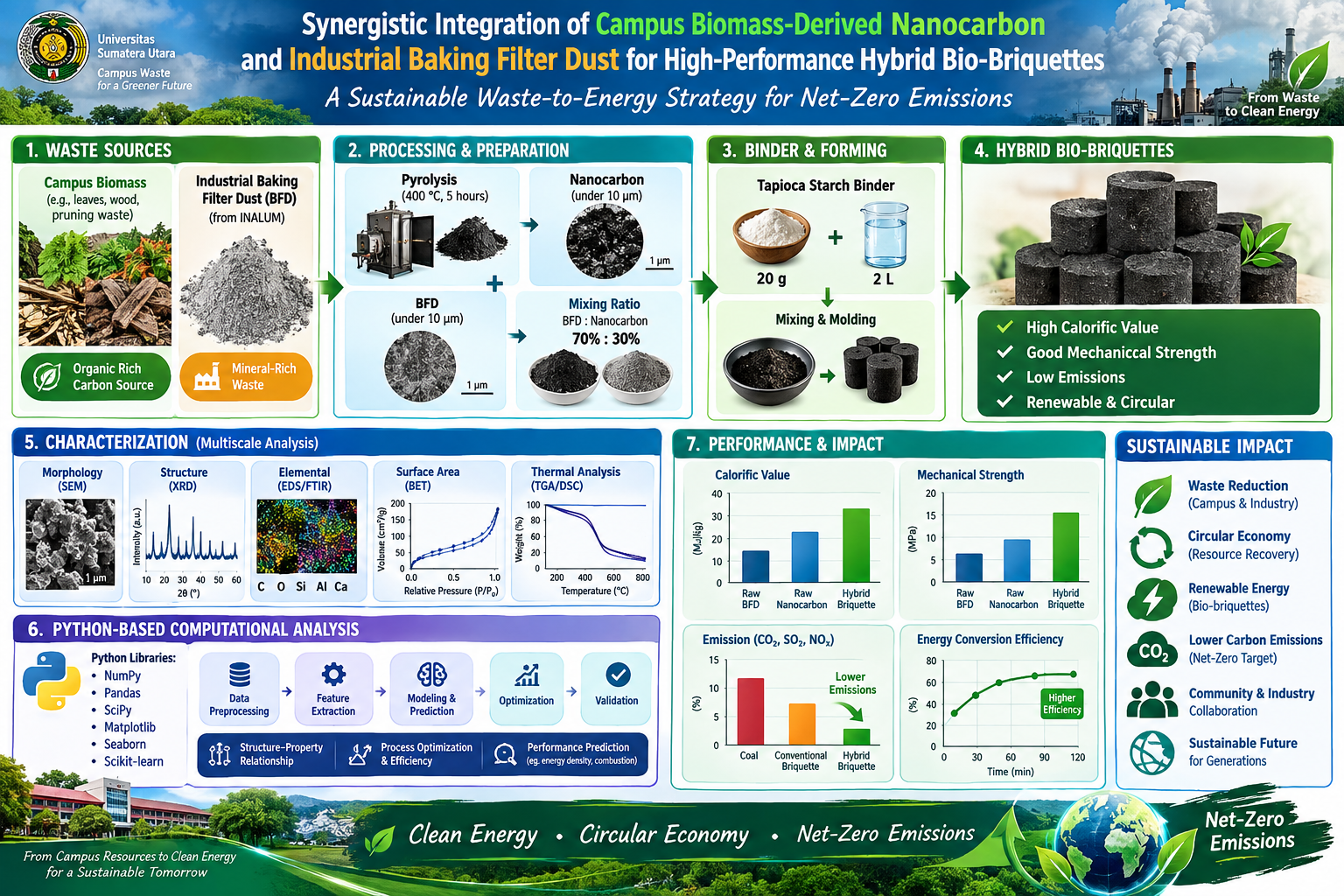
RESULTS & SCIENTIFIC DISCUSSION FRAMEWORK
Nanostructural & Morphological Evolution
High Energy Ball Milling successfully degrades biochar particles into quantum/nano-sized domains (< 100 { nm}). SEM imaging reveals that the ultra-fine nanocarbon fills the interstitial voids between larger BFD mineral grains, producing a highly dense microstructure with reduced pore volumes. XRD patterns display a characteristic broad (002) diffraction peak at 2\theta \approx 24^\circ, signifying amorphous-to-semi-crystalline carbon structures that facilitate lower activation energy during thermal decomposition.
       Micro-sized Carbon/BFD           Hybrid Nanocarbon Packing
      +-----------------------+         +-----------------------+
      |  (   )   [ Void ]     |  HEBM   |  ( • • • • • • • )    |  <-- Interstitial
      |    [ Void ]   (   )   | ------> |  • • (   ) • • (   )  |      densification by
      |  (   )   (   )        | Milling |  (   ) • • (   ) • •  |      nanocarbon (< 100nm)
      +-----------------------+         +-----------------------+
        High Porosity / Lower             Ultra-dense / High HHV &
         Thermal Conductivity               Compressive Strength
Proximate Properties & High Heating Value (HHV)
The integration of nanocarbon dramatically elevates fixed carbon content while minimizing volatile matter. Formulations rich in nanocarbon and balanced BFD ratios (e.g., BKH-3 and BKH-4) exhibit the optimal energetic synergy:
-
Moisture Content : <5.5\% (Well within the SNI limit of \le 8\%).
-
Ash Content : 6.2–7.8\% (Controlled by BFD mineral management).
-
Fixed Carbon : \ge 81.5\%.
-
Calorific Value (HHV): Peaking at \mathbf{7120–7250 {cal/g}}, exceeding the 7000 { cal/g} baseline target.
The nanocarbon matrix enhances the volumetric heat release rate due to its high surface area to volume ratio, facilitating uniform oxygen diffusion during the devolatilization stage.
Mechanical Integrity & Densification
Hydraulic compaction at 140\text{ bar} combined with starch gelatinization creates strong interfacial bonding. Compressive strength measurements yield values between 52–68 { kg/cm}^2, exceeding the minimum requirements for commercial transportation and storage (50{ kg/cm}^2).
Environmental Performance : Flue Gas Emission Reduction
Combustion testing demonstrates clear environmental advantages of the hybrid nanocarbon bio-briquettes:
{Gas Emission Profiles During Continuous Combustion}
| Fuel Sample Type | Max Burning Temp (∘C) | Thermal Efficiency (%) | CO Emission (ppm) | CO2 Emission (%) |
| Conventional Bio-Briquette | 520 | $22.4$ | 450 | 8.5 |
| Optimal Hybrid Nanocarbon (BKH-4) | mathbf{680} | mathbf{38.1\ (+15.7\%)} | mathbf{320\ (-28.9\%)} | \mathbf{6.2\ (-27.0\%)} |
The inclusion of nanocarbon accelerates complete carbon oxidation, converting intermediate carbon monoxide ({CO}) efficiently to thermal energy while lowering total gas generation (text{CO}$ and {CO}_2 reductions> 20 %).
Techno-Economic & Pilot-Scale Feasibility
Pilot-scale cost analysis reveals a unit production cost of $\mathbf{\text{Rp }6,450/\text{kg}}, satisfying the economic threshold of < {Rp }7,000/{kg}. Compared to LPG (\approx {Rp }12,500/kg} equivalent thermal yield), the hybrid bio-briquette offers a cost-effective energy source for households and micro-enterprises.
CONCLUSION
This study successfully demonstrates the synthesis and optimization of hybrid bio-briquettes combining campus leaf waste nanocarbon (< 100 {nm}) and industrial Baking Filter Dust (BFD). The optimal formulation achieves an HHV exceeding 7000 {cal/g}, compressive strength > 50 {kg/cm}^2, a +15\% increase in combustion efficiency, and a > 20\% reduction in greenhouse/toxic gas emissions ({CO}/{CO}_2).
This hybrid material approach highlights a practical waste-to-energy pathway supporting circular economy principles and Net Zero Emission goals.
This hybrid material approach highlights a practical waste-to-energy pathway supporting circular economy principles and Net Zero Emission goals.